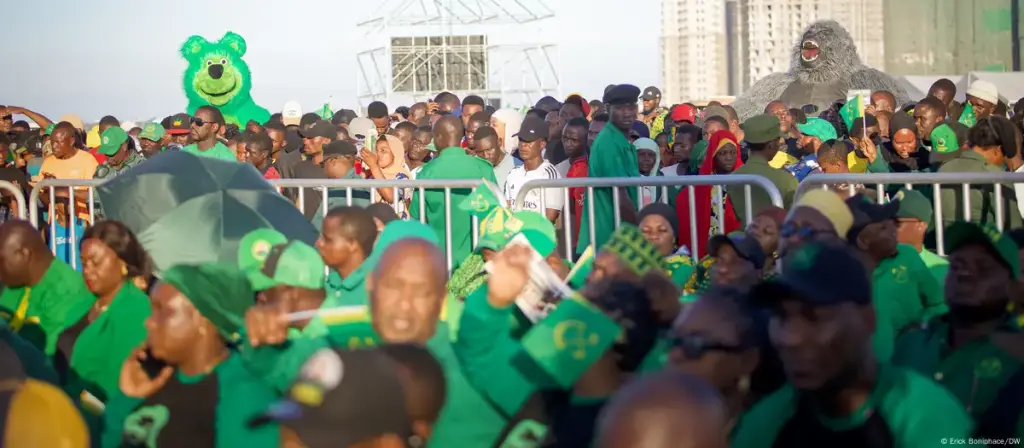
Tanzania's incumbent president, Samia Suluhu Hassan, told supporters on Thursday that she planned to spend the next five years not only improving their health and their children's education, but also drafting a new constitution and fostering national reconciliation.
Hassan said that she was guided by the so-called 4Rs — reconciliation, resilience, reform, and rebuild — a political strategy she adopted when she first assumed office in 2021.
"Guided by the 4Rs philosophy, we will continue consultations with political stakeholders, civil society organizations, and the private sector by forming a commission to initiate reconciliation and mediation talks, and to prepare the environment for a new constitution," she told thousands gathered at the rally, which took place at the Tanganyika Packers sports ground in Tanzania's commercial capital, Dar es Salaam.
Hassan took office following the sudden death of her predecessor, John Magufuli, under whom she served as vice president.
Under Magufuli, Tanzania's ruling Chama Cha Mapinduzi (CCM) party won with 84% of the 2020 vote, according to the country's election commission.
Many opposition candidates had been disqualified before the vote, and Amnesty International reported allegations of unlawful killings and torture of opposition members and arrested supporters and arbitrarily detained following the elections.
At least 14 people, mostly in Zanzibar, lost their lives in connection with the elections, according to Human Rights Watch.
Opposition hurdles
Several of Hassan's political opponents are not expected to run in the upcoming election, with some already disqualified or facing legal challenges.
Lissu, the current leader of the Tanzanian party for Democracy and Progress, commonly known as Chadema, and the party's 2020 presidential candidate, is currently in jail awaiting trial on treason charges, which carries the death penalty. He has denied the charges.
His party said earlier this year that it would boycott elections without reforms — including a more independent electoral commission and clearer rules to ensure its candidates are not removed from ballots.
Chadema was then disqualified from the election for refusing to sign an electoral "code of conduct."
This week, the electoral commission also disqualified Luhaga Mpina, candidate for the third-largest party, the Alliance for Change and Transparency (ACT Wazalendo), saying he lacked "qualifications."
ACT Wazalendo has taken the matter to court, describing the disqualification as "a deliberate state conspiracy against the opposition."
The party's chairman, Othman Masoud Othman, who is also its presidential candidate for Tanzania's semi-autonomous region of Zanzibar, criticized the move, calling it a reflection of "the childishness of the very institutions that govern the country's politics and elections."
"We would not have objected to any challenge if it had followed proper procedures," he said in a recent interview.
"But this decision by NEC shows how far behind we are. It's painful because it reveals how shamelessly CCM, despite its responsibility to this country, is using state institutions for such childish and disgraceful acts."
On the first day of the campaign, parties such as the National Reconstruction Alliance (NRA) and the Alliance for Democratic Change (ADC) failed to launch their campaigns in Mwanza and Arusha, citing various challenges, including lack of funding.
Lugete Mussa, a political analyst based in Dar es Salaam, noted that while Samia may face limited competition, "there have been major changes in the electoral system and there will be competition at the grassroots level.
"It might not be to the level of previous elections such as 2020, 2015, 2010 and 2005, but democracy is indeed blossoming in Tanzania," Mussa told DW.
"We have seen the electoral commission improve and even a high level of transparency and accountability for some officials of the commission," he added.
"And we have seen other improvements where journalists and editors are being involved in the electoral systems," Mussa said, noting that "the development of democracy has been better than it was in 2020."