Gayton McKenzie accused of not understanding fashion industry after his meeting with Shein
Fashion designer David Tlale said he doesn’t think Gayton McKenzie understands the complexities of the clothing and textile industry.



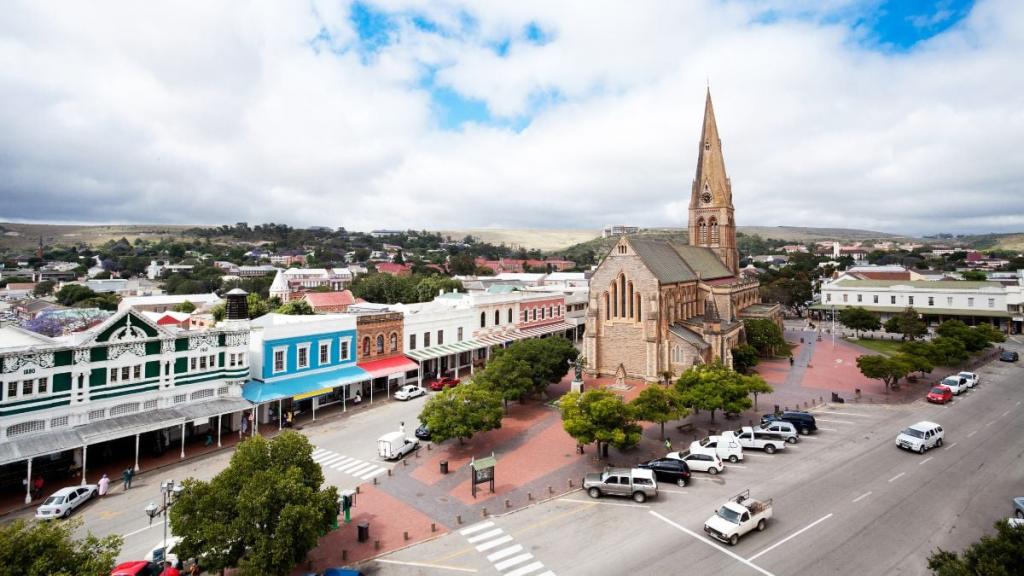
Makhanda, once known as Grahamstown, is a town home to Rhodes University, three well-known private schools, the Eastern Cape High Court, and the National Arts Festival.
However, despite its cultural and educational importance, the town is falling apart because of years of poor management by the Makana Local Municipality.
The decline was on full display during this year’s National Arts Festival in July. Visitors arriving after dark found the streets crumbling and almost completely unlit.
The festival has shrunk dramatically. Ten years ago, it attracted about 225,000 people and staged more than 600 shows.
In 2013, it contributed the equivalent of R460 million to the provincial economy, with R159 million going into Makhanda itself.
Last year, it generated just R132 million for the province and R58 million for the city. This year, there were only 242 shows, and audiences were visibly smaller.
The town’s failing services are a big reason for this decline. As early as 2016, then-festival CEO Tony Lankester warned that the biggest threat to the event was not a lack of funding.
It was the municipality’s inability to provide basic services like water and electricity. Residents have struggled with water shortages for over a decade, even when supply dams are full.
Large institutions have had to find their own solutions. Rhodes University, which has 9,000 students and is the town’s largest ratepayer, is building its own water treatment plant using borehole water.
“A significant challenge facing the university is the unreliable water supply from the Makana municipality,” said deputy vice-chancellor Professor Mabokang Monnapula-Mapesela in July.
The university is also exploring renewable energy to avoid relying on the fragile municipal electricity system.
The town’s top private schools have been forced to act as well. The Diocesan School for Girls and Kingswood College now use boreholes and rainwater harvesting.
St Andrew’s College still depends mainly on municipal water but switches to its own supplies during outages.

For ordinary residents, the picture is even worse.
Water leaks and sewage spills are common, and potholes have left many streets almost undrivable. Municipal buildings are also crumbling, and the electricity supply is unreliable.
The Auditor-General has repeatedly flagged serious problems in Makana’s finances, issuing the worst possible audit finding (disclaimer of opinion) every year since 2018/19.
This means the municipality’s books are in such a mess that they cannot even be properly checked. These failures have drawn the attention of the South African Human Rights Commission (SAHRC).
On 27 August this year, it called for the dissolution of the Makana council after yet another hearing on the town’s and municipality’s problems.
Commissioner Dr Henk Boshoff said the collapse of basic services like the water supply was violating residents’ rights. This was the second summons after the municipality ignored earlier orders to take urgent action.
The commission heard that the municipality has had support from provincial and national governments.
Treasury has provided the municipality with debt relief, while departments have funded infrastructure programmes and water treatment upgrades.
However, little has changed. Municipal manager Mpumelelo Kate admitted at the hearing that while the interventions were helpful, they were not enough.
Boshoff disagreed, arguing that the issue was poor management and not resources. He pointed to Kate’s own report, which suggested officials needed to be persuaded to “start performing their responsibilities.”
Boshoff said there had been a “blatant disregard” of the commission’s directives and called for either provincial government to dissolve the council or for the mayor to step aside voluntarily.
Makhanda is a town that should be thriving thanks to its university, schools, and cultural heritage. Instead, it is battling daily water, electricity, and infrastructure failures.
Institutions are being forced to fend for themselves, and residents are left with broken roads, sewage spills, and rationed water.
(With GroundUp)
Issued on BusinessTech by Malcolm Libera | https://businesstech.co.za/news/government/835703/south-african-town-with-historic-university-and-private-schools-crumbling-in-plain-sight/