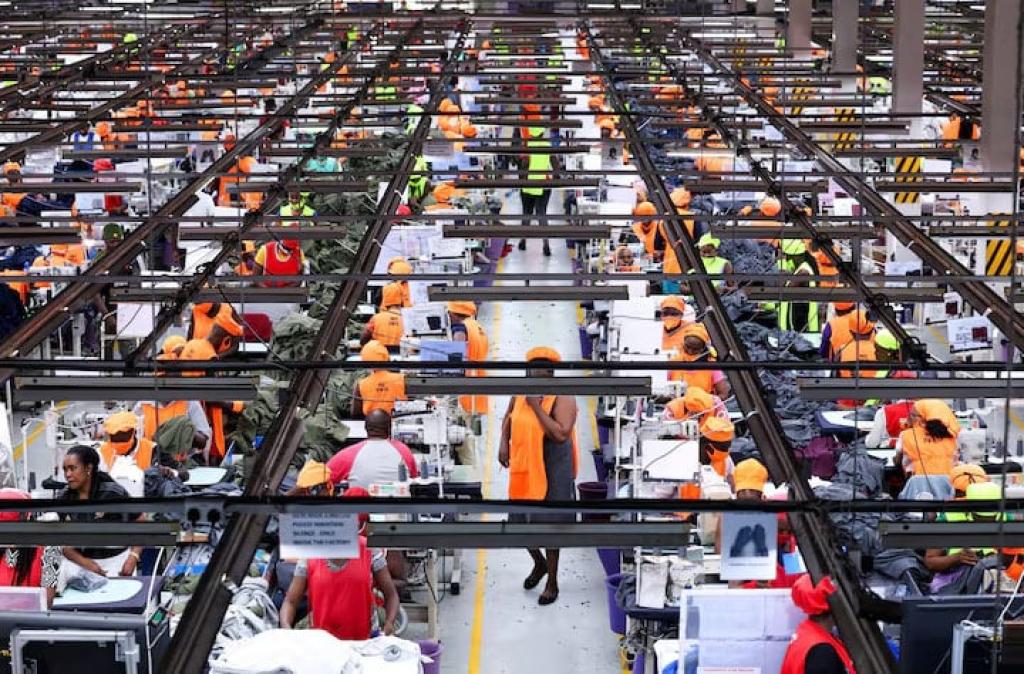
But some trade experts and economists say the possible end of the 25-year-old African Growth and Opportunity Act (AGOA) could allow African countries to seek potentially beneficial deals with other partners, or boost trade with each other.
Last-ditch talks on the future of AGOA have been taking place in Washington, but the fate of the deal is still unclear, although Lesotho's trade minister said last week that the U.S. plans to extend it by a year.
“AGOA is the breadbasket of many people in very critical sectors,” said Hod Anyigba, chief economist at the International Trade Union Confederation (ITUC) Africa, which has 17 million members.
"(But it) is not the only way to prosperity. It was one of the ways... but there could be other, better ways of trading," he told the Thomson Reuters Foundation.
US President Bill Clinton's administration passed AGOA in 2000 to deepen trade with sub-Saharan Africa and boost economic development.
It grants duty-free access to the U.S. market for thousands of African products, including motor vehicles and parts, textiles and clothing, minerals and metals, agricultural products and chemicals exported by eligible African countries.
But President Donald Trump's tariff trade policies have plunged the fate of the AGOA into doubt. However, African governments, manufacturers and unions have been lobbying the U.S. administration for a last-ditch temporary extension.
“Across both houses of Congress, both parties are keen on AGOA, but it’s a new U.S. politics where the president is very much … the key decision maker,” said Matthew Parks, parliamentary coordinator for the Congress of South African Trade Unions (COSATU), South Africa’s largest union federation.
This uncertainty means that if exporters find new markets, they need to “take the gap and run with it” to protect jobs, Parks said.
‘OUR COMPETITIVE EDGE’
From car factories in South Africa, to horticultural producers in Kenya, some 300,000 direct and 1 million indirect jobs are on the line if AGOA ends, Anyigba said.
Protecting these jobs is critical to halt mass migration into countries where migrants often face growing xenophobia, he said.
In Lesotho, a tiny, impoverished, landlocked country in southern Africa, union workers said an end to AGOA would see a spike in sex work and sexual abuse in workplaces as workers are forced into precarious situations by exploitative employers.
"Many women feel they have no choice. Ending AGOA will give them even fewer options," said Solong Senohe, general secretary of the United Textile Employees Union (UNITE), which represents more than 5,000 garment workers in Lesotho.
“AGOA means a lot to those workers, especially in a country with an unemployment rate of about 38% for youth,” he said.
In Kenya, the textile and horticultural sectors have benefited greatly from AGOA: Kenya’s exports to the U.S. grew from about $110 million in 2000 to approximately $570 million by 2020.
The East African nation has emerged as a leading exporter of textiles and apparel, which constitutes more than 90% of its exports under AGOA.
This sector has been vital for Kenya's export processing zones, creating more than 66,000 jobs directly, primarily benefiting women and young people.
AGOA has also facilitated market access for Kenyan horticultural products such as flowers, nuts and coffee.
“AGOA has been our competitive edge,” Pankaj Bedi, chair of the Apparels Manufacturers and Exporters at the Kenya Association of Manufacturers, wrote in the Business Daily newspaper.